
NeuroAtlas: Benchmarking Foundation Models for Clinical EEG and Brain-Computer Interfaces
arXiv preprint 2605.14698
1 KU Leuven, 2 MIT, * Equal contribution
Correspondence: konstantinos.kontras@kuleuven.be
Click a domain to jump to its results
Abstract
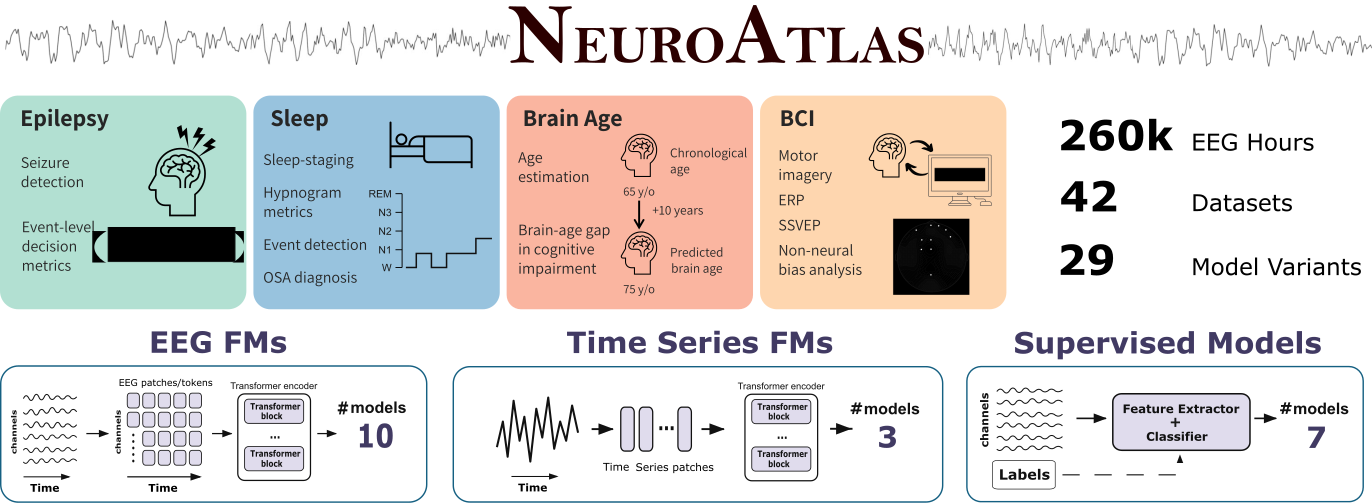
Foundation models (FMs) promise to extract unified representations that generalize across downstream tasks. They have emerged across fields including electroencephalography (EEG), but it is less clear how effective they are in this particular field. Published evaluations differ in datasets, in the EEG-specific preprocessing that might influence reported results, and in the reported metrics frequently obscuring the clinical relevance in EEG. We introduce NeuroAtlas, the largest EEG benchmark to date: 42 datasets and ~260k hours covering clinical EEG (epilepsy, sleep medicine, brain age estimation) and brain-computer interfaces, and include multiple datasets per task along with bespoke clinical evaluation metrics. Besides evaluating EEG-FMs with respect to supervised baselines, we present results from generic time-series FMs. We report three findings. First, EEG-specific FMs do not consistently outperform time-series FMs which have neither EEG-focused architectures nor been pretrained on EEG. Second, standard machine learning metrics are insufficient to assess clinical utility: Thus, we thoroughly evaluate more appropriate measures such as the quality of event-level decision-making, hypnogram-derived features, and the brain-age gap in the domains of epilepsy, sleep and brain age respectively. Third, model rankings and performance can vary substantially within domains. We conclude that pretrained models perform largely on par, with only narrow advantages for a few, and that current FMs do not yet deliver on the promise of an out-of-the-box unified EEG model. NeuroAtlas exposes this gap and provides the datasets and metrics for the next generation of unified EEG-FMs.
Main findings
EEG-FMs show no consistent advantage under linear probing
EEG-FMs performed similarly to supervised models and generic time-series foundation models (TS-FMs). The TS-FMs used neither EEG-specific architectures nor EEG data in pretraining.
Model rankings depend on the evaluation metric
Model rankings based on a single metric differed from those based on other clinically grounded metrics. Higher scores on standard metrics did not necessarily correspond to better performance on clinically relevant measures.
Performance and rankings vary across datasets
Both absolute performance and model rankings varied substantially across datasets within the same domain. Evaluation across multiple cohorts is therefore needed to assess how consistently a model performs.
Epilepsy
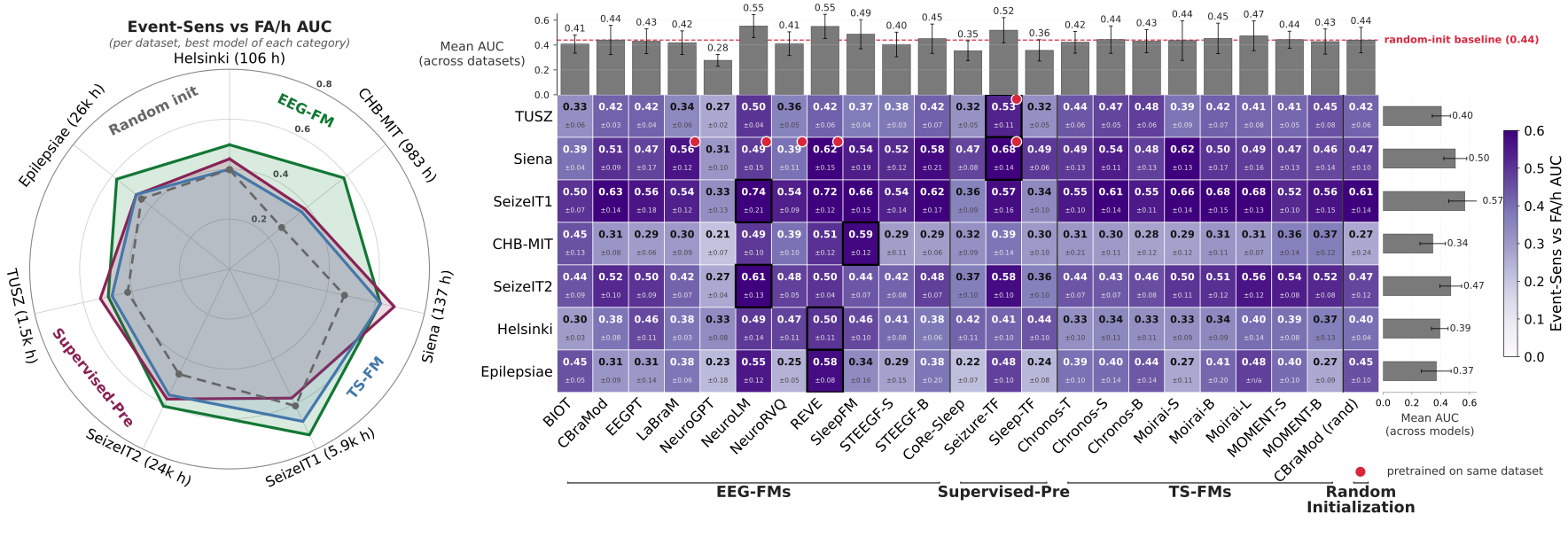
Seizure detection across seven EEG datasets.
Across the seven cohorts with continuous labels, no model or model family consistently came out on top. Most models performed within one fold standard deviation of the randomly initialized reference. Only NeuroLM and REVE placed in the top three more often than expected by chance.
Sleep
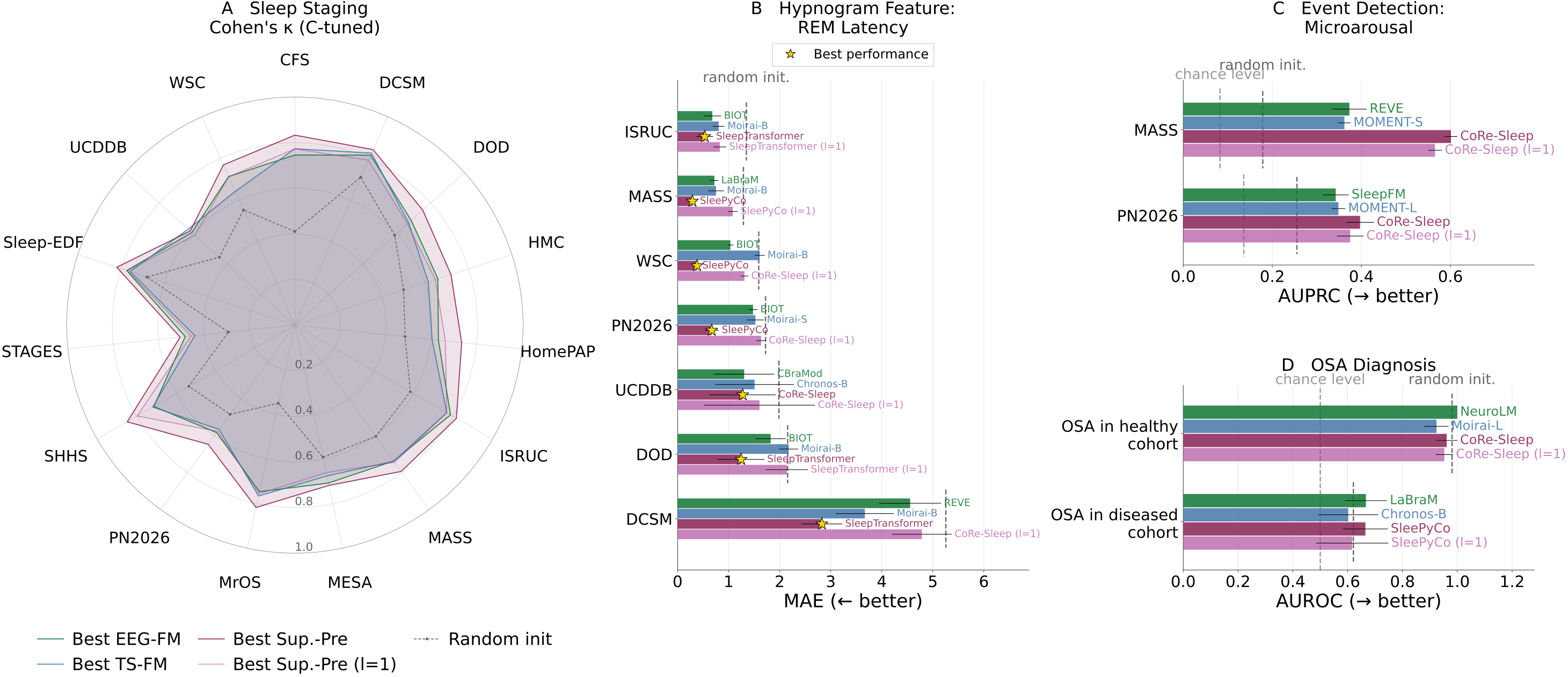
Sleep staging, hypnogram characterization, sleep-event detection, and obstructive sleep apnea assessment across 15 datasets.
Sleep-staging performance varied substantially across datasets. Without inter-epoch temporal context, EEG-FMs, TS-FMs, and supervised models performed similarly. Moreover, high agreement on individual epochs did not necessarily translate into accurate recovery of the hypnogram features used in clinical practice.
Brain Age
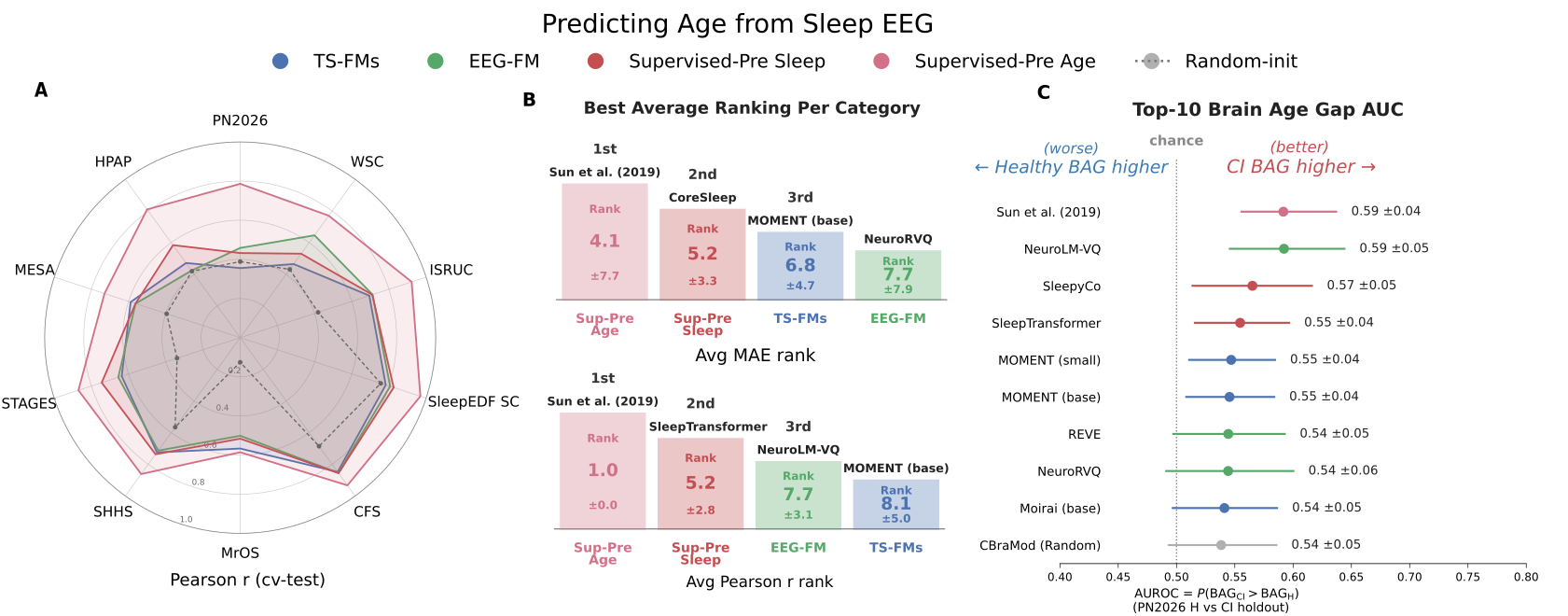
Age estimation and brain-age gap analysis across 10 sleep EEG cohorts.
Task-specific supervised models predicted chronological age more accurately than foundation models. However, brain-age gap estimates showed near-chance discrimination between participants with cognitive impairment and age-matched healthy controls across all models evaluated.
BCI
Motor imagery, ERP, SSVEP, and cognitive paradigms across 17 datasets, evaluated using leave-one-subject-out validation.
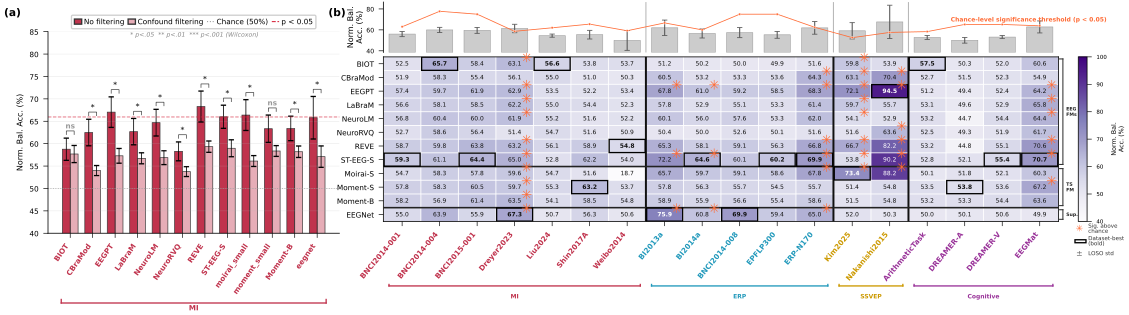
Once non-neural confounds are filtered out, motor-imagery performance often drops below significance, while no single foundation model consistently generalizes across BCI paradigms and subjects.
BibTeX
@misc{kontras2026neuroatlas,
      title={NeuroAtlas: Benchmarking Foundation Models for Clinical EEG and Brain-Computer Interfaces},
      author={Konstantinos Kontras and Trui Osselaer and Stylianos G. Mouslech and
              Angeliki-Ilektra Karaiskou and Guido Gagliardi and Thomas Strypsteen and
              Mohammad Hossein Badiei and Anku Rani and Maarten Vanmarcke and
              Miguel Bhagubai and Chanakya Ekbote and Jaedong Hwang and
              Christos Chatzichristos and Paul Pu Liang and Maarten De Vos},
      year={2026},
      eprint={2605.14698},
      archivePrefix={arXiv},
      primaryClass={cs.LG},
      url={https://arxiv.org/abs/2605.14698},
}


Acknowledgements
This work was supported by the Flemish Government under the METHUSALEM programme (METH/26/003, "Methusalem-BioMedAI: Explainable and generative AI for accelerating biomedical discoveries: from genome to function") and by the Flemish Government AI Research Program; several of the authors are affiliated with Leuven.AI of KU Leuven Institute for AI, B-3000 Leuven, Belgium. This work was also supported by the European Union's Horizon Europe research and innovation programme under the Marie Skłodowska-Curie Actions Doctoral Network InSilicoHealth (Grant Agreement No. 101169278). Further support was provided by KU Leuven through project C3/25/059 ("A Multicenter RCT on the impact of Wearable EEG and AI-Based Seizure Detection in absence seizure management"), and by the Research Foundation - Flanders (FWO) through research projects G046925N ("Task- and device-agnostic Artificial Intelligence (AI) for EEG analysis"), and G0C9623N ("Artificial Intelligence (AI) for data-driven personalised medicine"), as well as FWO PhD fellowships 1166926N, 1107725N, 1S30225N, 1S12523N, 1SB5922N, 1S61822N and 1SH4Z24N. The collaboration was also supported by the MIT-Belgium-KU Leuven Seed Fund. The resources and services used in this work were provided by the VSC (Flemish Supercomputer Center), funded by the Research Foundation - Flanders (FWO) and the Flemish Government. We acknowledge LUMI-BE for awarding this project access to the LUMI supercomputer, owned by the EuroHPC Joint Undertaking, hosted by CSC (Finland) and the LUMI consortium through a LUMI-BE Regular Access call. LUMI-BE is joint effort from BELSPO (federal), SPW Économie, Emploi, Recherche (Wallonia), Department of Economy, Science & Innovation (Flanders) and Innoviris (Brussels).